Louis Poulsen
There are no products in this collection. Keep on shopping.
Choosing a Louis Poulsen luminaire: diameter, bulb base, installation height
Three measurements determine the choice, and Louis Poulsen publishes them on its product pages. The luminous flux in lumens and the color rendering index are not included.
Diameter
It determines the illuminated area and the clearance above a table. The PH 5 is available in Ø 50 cm and Ø 30 cm, the PH Artichoke from Ø 48 cm to Ø 84 cm, and the VL 45 Radiohus in Ø 17.5 cm.
The ten pieces measuredBulb base
The brand specifies an E27 base for the Ø 50 cm PH 5 and an E14 base for the Ø 30 cm version. The bulb is not included. For models with integrated LED, it publishes the color temperature and the wattage.
E27 base luminairesInstallation height
The brand describes the PH 5 above a dining table, placed in pairs for long tables; large PH Artichoke diameters for high ceilings in halls and entrances; the PH Snowball for spaces with lower ceilings. None of these rules are strict thresholds in meters.
See the PH 5Pendants, table lamps, wall lamps, and floor lamps: what each family solves
This collection includes 104 references as of September 14, 2026, all from Louis Poulsen.
Pendants
The diameter should be chosen before the color and finish: it determines the illuminated area and the clearance above a table.
See pendantsTable lamps
For a desk, a console, or a bedside table: total height and arm reach dictate the choice.
See table lampsWall lamps
The projection, i.e., the distance the luminaire extends from the wall, determines the clearance in a passageway.
See wall lampsFloor lamps
For a reading nook or a living room corner, where no anchor point exists on the ceiling.
See floor lampsWhat Louis Poulsen publishes, and what no one publishes
The three-shade principle
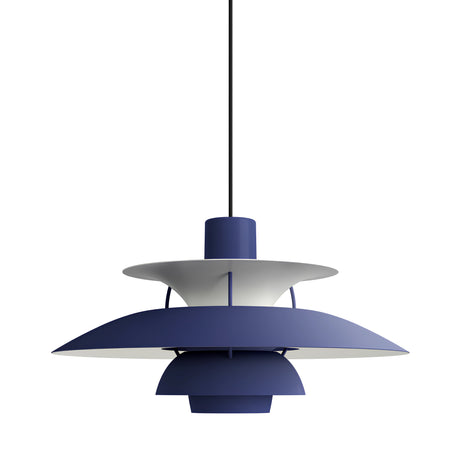
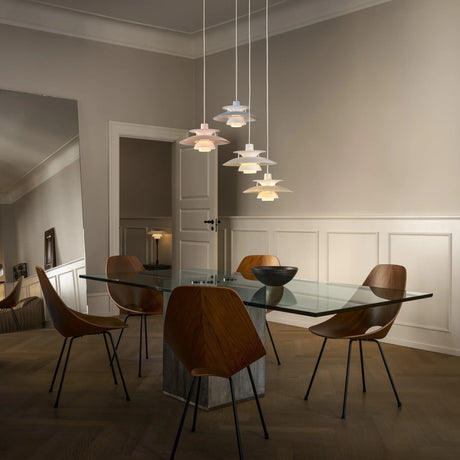
The PH series is based on three superimposed shades: the top one made of metal, and the two bottom ones made of blown opal glass. The brand notes that this combination directs light downward through reflection on the white inner surface of the first shade.
The brand's Heritage page, accessed on September 14, 2026, provides two dates. The collaboration between Louis Poulsen and Poul Henningsen began in 1924. The resulting lamp received a gold medal at the 1925 Paris Exhibition.
1874: a company born in wine
Founded in Copenhagen in 1874 under the name Kjøbenhavns Direkte Vin Import Kompagni, the company originally imported wine.
It was the commissioning of the city's first power plant in 1892 that shifted its focus toward lighting.
The figures the brand publishes
On its product pages, the brand publishes the diameter, the designer, the creation year, and the bulb base type: the Ø 50 cm PH 5 takes an E27 base, the Ø 30 cm version takes an E14, and the bulb is not provided. For models with integrated LED, it adds the color temperature in Kelvins and the power in watts.
What it does not publish on these same pages: the luminous flux in lumens, the color rendering index, or the weight. The choice depends on three other dimensions: diameter, bulb base, and installation position.
Ten Louis Poulsen luminaires, from the PH 5 to the Panthella
Ten pieces selected based on criteria written before selection: one model per line, never two colors of the same luminaire, all four types covered, and a designer accompanied by a year or a creative fact documented on the brand's page.
 PH 5
Louis Poulsen · Poul Henningsen, 1958
Developed in 1958 to remain usable with any light source, regardless of the bulb shape.
PH 5
Louis Poulsen · Poul Henningsen, 1958
Developed in 1958 to remain usable with any light source, regardless of the bulb shape.
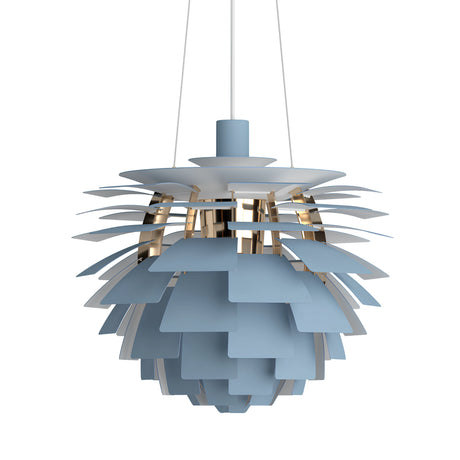
 PH Artichoke
Louis Poulsen · Poul Henningsen, 1958
72 metal leaves in 12 rows of six. Designed for the Langelinie Pavillonen restaurant in Copenhagen, based on sketches from 1927 to 1931.
PH Artichoke
Louis Poulsen · Poul Henningsen, 1958
72 metal leaves in 12 rows of six. Designed for the Langelinie Pavillonen restaurant in Copenhagen, based on sketches from 1927 to 1931.
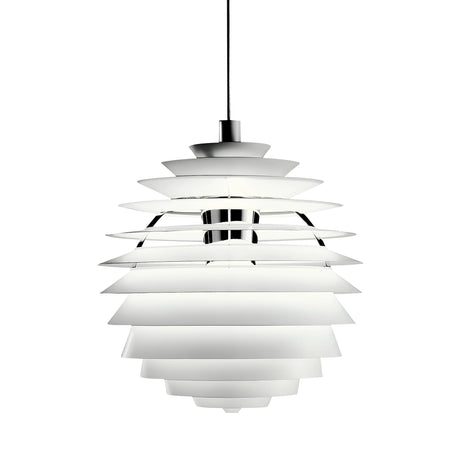
 PH Snowball
Louis Poulsen · Poul Henningsen, reintroduced in 1983
Eight shades mounted on three struts, unlike the more numerous ones on the PH Louvre from which it is derived.
PH Snowball
Louis Poulsen · Poul Henningsen, reintroduced in 1983
Eight shades mounted on three struts, unlike the more numerous ones on the PH Louvre from which it is derived.
 PH Septima
Louis Poulsen · Poul Henningsen · 1928 prototype
Three tiers of glass inserted between the three main shades. The prototype was presented in 1928 at the Danish Museum of Decorative Art.
PH Septima
Louis Poulsen · Poul Henningsen · 1928 prototype
Three tiers of glass inserted between the three main shades. The prototype was presented in 1928 at the Danish Museum of Decorative Art.
 VL 45 Radiohus
Louis Poulsen · Vilhelm Lauritzen, late 1930s
Designed for the Radio House in Copenhagen, inaugurated in 1945. Ø 17.5 cm, compared to Ø 50 cm for the PH 5.
VL 45 Radiohus
Louis Poulsen · Vilhelm Lauritzen, late 1930s
Designed for the Radio House in Copenhagen, inaugurated in 1945. Ø 17.5 cm, compared to Ø 50 cm for the PH 5.
 Panthella 400
Louis Poulsen · Verner Panton, 1971
400 mm hemispherical shade above a trumpet base: the light travels down, reflects on the base, and goes back up.
Panthella 400
Louis Poulsen · Verner Panton, 1971
400 mm hemispherical shade above a trumpet base: the light travels down, reflects on the base, and goes back up.
 AJ
Louis Poulsen · Arne Jacobsen, 1957
Designed for the SAS Royal Hotel in Copenhagen along with other furniture and decor pieces. The hotel opened in 1960. The shade can be adjusted to regulate light distribution.
AJ
Louis Poulsen · Arne Jacobsen, 1957
Designed for the SAS Royal Hotel in Copenhagen along with other furniture and decor pieces. The hotel opened in 1960. The shade can be adjusted to regulate light distribution.
 NJP
Louis Poulsen · nendo and Oki Sato
A reinterpretation of the architect's lamp: two joints on the arm adjust the position.
NJP
Louis Poulsen · nendo and Oki Sato
A reinterpretation of the architect's lamp: two joints on the arm adjust the position.
 Flindt Wall
Louis Poulsen · Christian Flindt
The only piece in this selection for which Louis Poulsen publishes the color temperature and power: Ø 20 cm, integrated LED 2700 K, 10 W.
Flindt Wall
Louis Poulsen · Christian Flindt
The only piece in this selection for which Louis Poulsen publishes the color temperature and power: Ø 20 cm, integrated LED 2700 K, 10 W.
 PH 3½-2½ Centenary Edition
Louis Poulsen · Poul Henningsen, 1928
The brand dates the PH 3½-2½ to 1928 and describes it as a table lamp. This edition is a floor lamp.
PH 3½-2½ Centenary Edition
Louis Poulsen · Poul Henningsen, 1928
The brand dates the PH 3½-2½ to 1928 and describes it as a table lamp. This edition is a floor lamp.
Filter the collection by color, material, and bulb base
Each chip opens the filtered grid to a facet of the catalog. The bulb base is included here because it is one of the three dimensions upon which the choice is made.
By color
By material
By bulb base
Louis Poulsen lighting dimensions: diameter, designer, date
Louis Poulsen publishes dimensions followed by an asterisk on their product pages. Others have been collected on our fact sheets: of the five diameters also published by the brand, both sources provide the same value, which makes our measurements verifiable one by one. "Not published" means that the brand does not provide the value: neither in the body of the page nor in the size selector.
| Piece | Type | Dimension | Designer | Documented date | References in its family |
|---|---|---|---|---|---|
| PH 5 | Pendant | Ø 50 cm* | Poul Henningsen | 1958 | 21 |
| PH Artichoke | Pendant | Ø 48 cm* | Poul Henningsen | 1958 | 6 |
| PH Snowball | Pendant | Ø 40 cm | Poul Henningsen | reintroduced in 1983 | 2 |
| PH Septima | Pendant | Ø 50 cm | Poul Henningsen | prototype 1928 | 1 |
| VL 45 Radiohus | Pendant | Ø 17.5 cm* | Vilhelm Lauritzen | late 1930s | 4 |
| Panthella 400 | Table lamp | Ø 40 cm* | Verner Panton | 1971 | 14 |
| AJ | Table lamp | not published | Arne Jacobsen | 1957 | 9 |
| NJP | Table lamp | not published | nendo and Oki Sato | not published | 3 |
| Flindt Wall | Wall light | Ø 20 cm* | Christian Flindt | not published | 1 |
| PH 3½-2½ Centenary Edition | Floor lamp | not published | Poul Henningsen | 1928, table lamp | 2 |
Louis Poulsen designers: Poul Henningsen, Arne Jacobsen, Verner Panton
Out of 104 references, 100 carry a designer name on their sheet. Four do not: two Toldbod 155s and two Skots. The 54 references by Poul Henningsen are the 54 pieces in this collection whose names start with PH.
| Designer | References in this collection |
|---|---|
| Poul Henningsen | 54 |
| Verner Panton | 14 |
| Arne Jacobsen | 12 |
| Vilhelm Lauritzen | 11 |
| nendo and Oki Sato | 3 |
| Finn Juhl | 3 |
| Olafur Eliasson | 1 |
| Christian Flindt | 1 |
| Gabriel Tan | 1 |
Frequently asked questions about Louis Poulsen lighting
What does the number of a PH light mean?
Louis Poulsen does not publish a rule for reading these numbers, and the catalog prohibits a simple one: the PH 5 measures Ø 50 cm, but the PH 3/2 measures Ø 28.5 cm and the PH 3½-2½ Ø 33 cm.
Which bulb for a PH 5?
The brand indicates an E27 socket on the 50 cm PH 5 and an E14 socket on the 30 cm version. The bulb is not supplied with the light.
What diameter pendant above a table?
Louis Poulsen describes the PH 5 as being placed above a dining table and, for long tables, installed in pairs.
How many lights are in this collection?
104 as of September 14, 2026: 45 table lamps, 39 pendants, 17 wall lights, and 3 floor lamps.
How long has Louis Poulsen been making lights?
The company was founded in Copenhagen in 1874 under the name Kjøbenhavns Direkte Vin Import Kompagni, to import wine. It switched to lighting after the commissioning of the city's first power plant in 1892. The collaboration with Poul Henningsen began in 1924.
Which piece for a low ceiling?
The PH Snowball. The brand describes it as a reduced-diameter version of the PH Louvre, with eight shades instead of more, intended for spaces with lower ceilings.
To go further
The PH series
Related collections
The catalog
Dates, diameters, sockets, and optical principles collected from louispoulsen.com on September 14, 2026. Reference counts collected from the catalog on the same day.