
Designer wall lights
Choosing between wall lights?Three choices to explore lighting effects and the details to check.
Help me choose


An informed choice
A wall light that adapts
to the way you live.
A specific use, a location, a detail to check. Find the effects to compare and the useful benchmarks for your project.
Your starting point
Three benchmarks for your project.
Understand before choosing
The wall light guide
Usages, installation, materials, and sources.
Each benchmark remains freely accessible.
Choosing a wall light according to your usage
Start with what you want to illuminate: a page, the sofa area, an entryway, or the wall itself. Then choose the light effect, followed by dimensions and finishes. A wall light may be suitable for several uses; here are starting points to compare models.
| Your usage | Desired effect | A model to compare | Point to verify |
|---|---|---|---|
| Reading in bed or near an armchair | Adjustable lighting directed at the page. | Black Tolomeo Micro Wall: articulated arm and adjustable head. | The reach of the arm and visibility of the source from your reading position. |
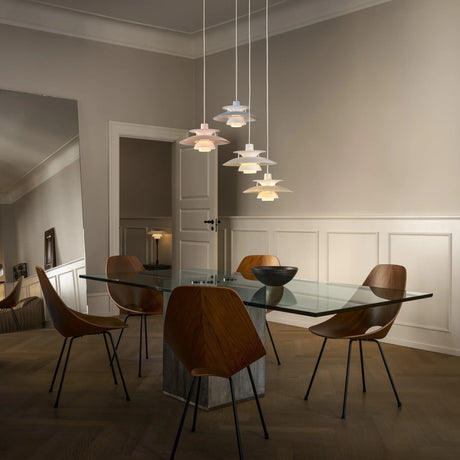
| Creating an atmosphere in the living room | Diffused light, primarily directed downward. | PH 2/1: three opal glass shades. | The footprint near furniture and the power supply version: corded or hardwired. |
| Illuminating an outdoor entrance | Light directed toward the ground. | Black Toldbod 155: IP44, class I. | Exposure to water and the grounding connection required by its electrical class. |
| Highlighting a wall or walkway | A halo around the texture, combined with downward light. | Flindt Wall: three diameters, IP65. | The proportion on the wall and the dimming control, which depends on the chosen diameter. |
To compare available light, read the flux in lumens and verify whether it refers to the bulb or the complete luminaire. The result on a page or wall also depends on the diffusion and distance: a flux value alone does not predict comfort.
Before installation, check for glare from positions actually occupied, then the space required for the luminaire and its movements. A paper silhouette helps to appreciate its footprint; it does not allow you to judge its light.
Before ordering, finally check for the presence of an electrical outlet or junction box, access to the control, dimmer compatibility, and possibilities for replacing the bulb or LED module. These points can be verified on the exact reference and its manual.
Where to mount a wall light: what no standard defines
No French standard prescribes the mounting height for a wall light in a home. The AFNOR catalog contains no residential lighting standards: the only texts that quantify illumination levels, NF EN 12464-1 and NF EN 12464-2, concern workplaces. The NF C 15-100 establishes safety volumes and heights, but never comfort heights.
The measurements in centimeters circulating in this category are therefore merchant conventions, not rules. We do not publish any of them.
Bathroom: the volumes required by regulations
The NF C 15-100 divides the bathroom into volumes, and the minimum IP rating for the luminaire depends on the volume where it is placed.
The current division has four volumes: volume 0, volume 1, volume 2, and the hidden volume, followed by the space outside any volume. Volume 3 has been removed by amendment A5, to harmonize with the European CENELEC standard. The space under the bathtub or shower tray has become the hidden volume.
In volume 1, whose upper limit is 2.25 m above the bathtub or shower tray, equipment must be powered by safety extra-low voltage (12 V maximum) and must have an IPX4 protection rating (IPX5 in case of water jets). Volume 2 extends 0.60 m beyond volume 1. Outside these volumes, the restrictions specific to volumes 0, 1, and 2 cease to apply, but general electrical safety rules remain in effect.
Where volume 2 begins
One point is often misread: the 60 cm is not counted from the edge of the bathtub, but from the limit of volume 1. For a walk-in shower without a tray, volume 1 is a cylinder with a 1.20 m radius around the reference point. Volume 2 therefore extends from 1.20 m to 1.80 m from the reference point, subject to wall configuration.
Two texts, and they do not say the same thing
Normatively, the bathroom has been subject to NF C 15-100-7-701 since August 21, 2024, which has been systematically applied since September 2025. Regulatorily, the decree of August 3, 2016, still maintains the presumption of conformity for the 2002 version and its amendments A1 to A5. Volume 3 is absent from both readings.
Outdoor: what each digit of an IP rating protects
The IEC 60529 standard, transposed in France as NF EN 60529, defines a two-digit index, each measuring a different attribute. The first digit measures protection against solid objects, the second against water.
A first digit of 4 signifies protection against solid objects 1.0 mm in diameter and larger. A 6 means dust-tight, with no ingress whatsoever. A second digit of 4 signifies protection against splashing water from all directions, and a 5 against water jets.
The correspondence between these indices and real-world exposure, whether under an awning or in the open air, is not covered by any standard: Louis Poulsen recommends at least IP44 for a covered terrace and at least IP65 for direct exposure to rain and snow, and this is a manufacturer's recommendation, not a rule.
Three wall lamps, three ratings

The PH 2/1 by Louis Poulsen is rated IP20: no protection against water. Its dimensions are 200 × 165 × 296 mm. It is a wall lamp for a living room or bedroom, outside of any bathroom volume.

The Toldbod 155, from the same manufacturer, is rated IP44 and IK05, measuring 155 × 158 × 267 mm. Its head and arm are made of cast aluminum, and its shade is laser-cut satin acrylic. Its second digit of 4 satisfies the IPX4 requirement for volume 2.

The Flindt Wall is rated IP65. It comes in three diameters—200, 300, and 400 mm—with an impact resistance rating that increases with the size: IK08 for the 200 mm model, and IK09 for the 300 and 400 mm models.
Reading power: the official lumen equivalence
European Regulation 2019/2015 publishes an official equivalence table for non-directional sources: 136 lm corresponds to 15 W, 249 lm to 25 W, 470 lm to 40 W, and 806 lm to 60 W. The regulation requires linear interpolation between two adjacent values.
This rule is enough to correct a common approximation: 300 lm is not equivalent to 40 W but to 28 W, and 500 lm is equivalent to 42 W. The exact equivalent of the old 40 W bulb is 470 lm, not a range.
No standard, however, prescribes a flux per wall lamp based on the room. What is standardized is the illuminance in lux received on a surface, which depends on the number of luminaires, their height, their photometry, and the reflectance of the walls. A lumen figure given for a living room, without these four parameters, means nothing.
Articulated arm: a position that can be adjusted after installation

The Artemide Tolomeo Micro Parete measures 490 mm in length and its extension reaches 740 mm: the lighting point moves well beyond the mounting bracket.
Materials and diffusers
 The Louis Poulsen PH 2/1 features a shade made of mouth-blown, three-layer opal glass. The Produzione Privata Acquaparete, 11 cm in diameter and 18 cm high, uses the same process on clear glass.
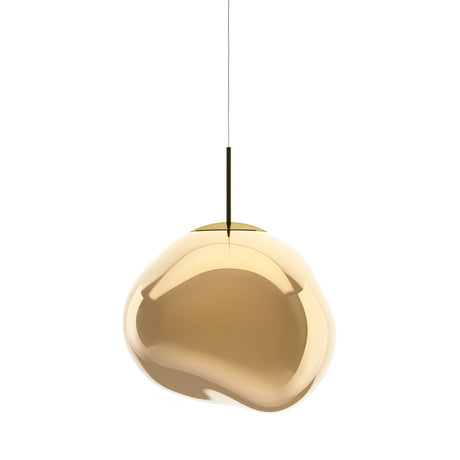
 The Beat by Tom Dixon, measuring 22.5 × 13 × 29 cm, is made of spun brass, then hand-hammered by artisans in northern India: each piece requires four days to craft.
What the brands publish about these pieces
The pieces mentioned above come from four brands. What follows is what each publishes itself, unless another source is mentioned. A piece for which the brand publishes neither the designer nor the year is not presented as dated: the omission is intentional.
Louis Poulsen
The PH 2/1 belongs to the three-shade system that Poul Henningsen designed in 1925 and 1926, the first luminaires of which were presented at an exhibition in Paris. The brand does not publish the year for this specific wall lamp model.
The AJ family was designed by Arne Jacobsen for the SAS Royal Hotel in Copenhagen, which opened in 1960. The AJ 50, derived from it, was launched in 2010 and is rated IP65 and IK06.
The Flindt Wall is signed by Christian Flindt and has been produced since October 2018. The brand does not publish a design year, only this market launch date. It received the Danish Design Award in 2019.
The Toldbod 155 has no individual designer: Louis Poulsen credits it to its own name. Launched in 2006, its design incorporates the PH Ellipse reflector, and it meets full cut-off criteria, which limit emission above the horizontal.
Artemide
The Tolomeo was designed by Michele De Lucchi and Giancarlo Fassina and launched on the market in 1987. It received the Compasso d'Oro in 1989. The Micro Parete is a reduced version; the brand does not publish a year specific to this version.
The Dioscuri is signed by Michele De Lucchi. None of the brand's official pages publish its year of creation. What is dated are its accolades: a Red Dot from the Design Zentrum NRW and a Design Plus award at Light + Building, both in 2000. We sell it in four diameters, from 14 to 42 cm, and Artemide restricts outdoor use to the 25, 35, and 42 versions.
Produzione Privata
The Acquaparete is signed by Michele De Lucchi and Alberto Nason, from 1998. It is the wall-mounted version of the Acquatinta pendant, a drawing of which from 1996 is held at the Centre Pompidou.
Tom Dixon
The Beat is the only piece in this selection for which the brand publishes neither the designer's name nor the year.
Frequently asked questions
Can a wall lamp replace a bedside lamp?
Yes, if the wall lamp illuminates the book and its control remains accessible from the bed. For reading, an articulated arm and an adjustable head, like those of the Tolomeo Micro Wall, allow you to direct the light onto the page. Before mounting, check the reach of the arm, the accessibility of the switch, and ensure there is no glare in your usual reading position: a single height is not suitable for all beds.
Sources: Artemide — Tolomeo Micro Wall.
How do I mount a wall lamp without drilling the wall?
Choose a model for which the manufacturer explicitly provides a drill-free mounting system suitable for your surface; do not replace the mounting hardware from the instructions with unapproved adhesive. A wall lamp with a cord and plug avoids the need for an electrical outlet on the wall but still requires mounting: the PH 2/1 exists with or without a cable, with the latter version intended for permanent wiring, not for battery use. If the wall must remain intact, a table lamp is another solution.
Do all LED wall lamps work with a dimmer?
No: the bulb or LED module and the dimmer must be compatible. With a replaceable bulb, check for the term "dimmable" as well as the power range accepted by the dimmer. With an integrated LED, consult the control method for that specific reference: Louis Poulsen, for example, indicates that the Flindt Wall Ø 200 mm accepts phase-cut dimming; this indication does not mean that just any dimmer can be chosen.
Sources: Legrand — bulbs and dimmers; Louis Poulsen — Flindt Wall (PDF).
Must the entire wall lamp be replaced if its LED stops working?
Not necessarily: an integrated LED is not always a non-replaceable source. The PH 2/1 uses an E14 bulb, while the Flindt Wall has an integrated LED for which Louis Poulsen provides a replacement kit to be installed by a licensed electrician. Before purchasing or attempting a repair, consult the model's manual to check for source and driver replacement options, as well as parts availability.
Sources: Louis Poulsen — PH 2/1 (PDF); Louis Poulsen — Flindt Wall LED replacement (PDF).
Is an IP44 wall lamp automatically suitable for the bathroom?
No: the IP44 rating is not sufficient, as the location and the electrical class of the luminaire also count. For 230 V lighting in volume 2, Promotelec requires Class II, an IPX4 protection, and a 30 mA residual current device (RCD); the Toldbod 155, despite being IP44, is Class I and is therefore not suitable for this location. Have the relevant volume and the choice of wall lamp approved by the electrician in charge of the installation.
Sources: Promotelec — volume 2 lighting; Louis Poulsen — Toldbod 155, technical sheet (PDF).
Answers verified on September 16, 2026.
Sources
Bathrooms and volumes: NF C 15-100-7-701, published August 21, 2024, and the decree of August 3, 2016, regulating electrical installations in residential buildings, NOR LHAL1522022A. Public interpretation of volumes: Association Promotelec.
Degrees of protection provided by enclosures, IP code: IEC 60529, consolidated edition 2.2 of 2013, and its French transposition NF EN 60529 with its amendment A2 of May 2014.
Equivalence between luminous flux and power: Commission Delegated Regulation (EU) 2019/2015, Annex V, Table 7, version consolidated as of September 30, 2023.
Designers, years, dimensions, and ratings of the pieces mentioned: official pages of Louis Poulsen, Artemide, Produzione Privata, and Tom Dixon, consulted on September 16, 2026.